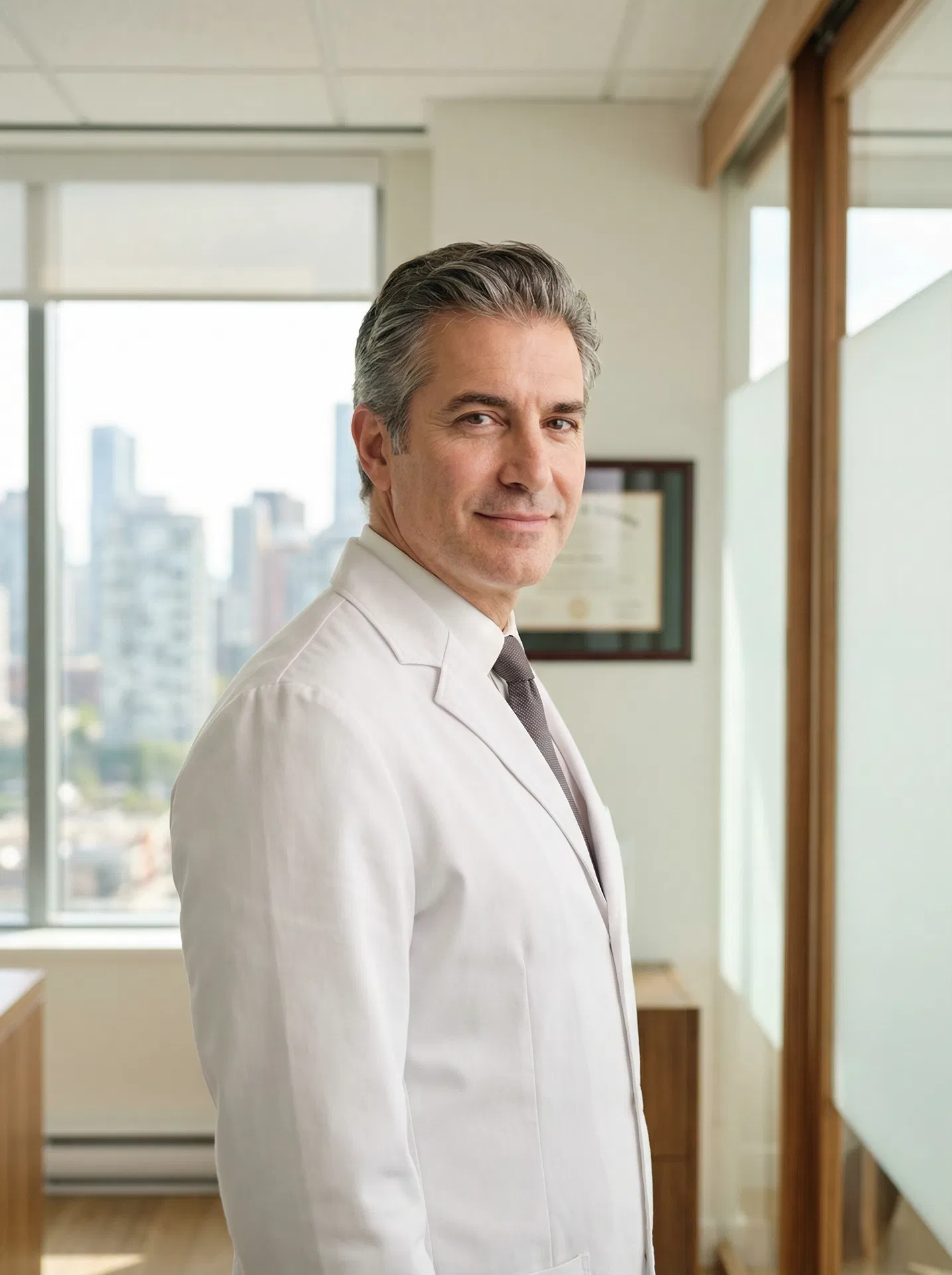
RhinoplastyRhinoplasty at 8 WestOver 2,500 rhinoplasty procedures performed. Dr. Buonassisi is one of Canada's most experienced facial plastic surgeons.
TechniquesRhinoplasty TechniquesEvery approach available — open, closed, preservation, ethnic, revision & more. The right technique is chosen for your anatomy.
Before & AfterReal Patient ResultsEvery case performed by Dr. Buonassisi. Unretouched photos published with patient consent — use filters to find cases matching your anatomy.
Why 8 WestWhy Rhinoplasty at 8 WestRhinoplasty is the only procedure Dr. Buonassisi performs. 4,000+ procedures, 25 years of focused practice, accredited facility.
Dr. Thomas Buonassisi, FRCSC, ABFPRSAuthor · Reviewer
Facial Plastic Surgeon · Founder, 8 West Clinic · Vancouver, BC
Dr. Buonassisi is a dual board-certified facial plastic surgeon with over 25 years of experience in facial surgery exclusively. He has performed over 2,500 rhinoplasties and is the founder of 8 West Clinic in Vancouver. All content in the Knowledge Hub is written or reviewed directly by Dr. Buonassisi.
FRCSCABFPRSAAFPRSABOHNS
Free Resource
The Vancouver Rhinoplasty Guide
40+ pages written by Dr. Buonassisi. Candidacy, techniques, recovery, costs, and how to choose a surgeon. Free — no commitment required.
<h2>What Does It Mean to Be a Candidate for Rhinoplasty Surgery?</h2> <p>Determining candidacy for rhinoplasty involves both personal reflection and professional assessment. Dr. Thomas Buonassisi, MD, FRCSC — Specialist in Otolaryngology – Head and Neck Surgery, with a practice limited to facial plastic surgeries — explains that being a candidate means evaluating whether the surgery aligns with your needs and expectations. It's crucial to consider if the procedure addresses an irregularity or shape of your nose that concerns you and if you can accept that perfection is not guaranteed.</p> <p>From a surgeon's perspective, candidacy involves assessing whether the desired changes are feasible. Rhinoplasty can effectively address issues like reducing a bridge or adjusting the tip, but it cannot alter skin thickness. Understanding these limitations is vital for both the patient and the surgeon to ensure realistic expectations.</p> <h2>Health Considerations for Rhinoplasty Candidates</h2> <p>Dr. Buonassisi emphasizes the importance of both physical and emotional health when considering rhinoplasty. Candidates must be healthy enough to undergo surgery without undue risk of complications. This includes being free from conditions that could increase surgical risks and being emotionally prepared for the changes that rhinoplasty entails.</p> <p>Emotional readiness is particularly important, which is why younger patients are approached with caution. Ensuring that candidates have a mature understanding of the surgery's impact is crucial for a successful outcome.</p> <h2>Understanding the Benefits and Risks of Rhinoplasty</h2> <p>A thorough understanding of the benefits and risks associated with rhinoplasty is essential for any candidate. Dr. Buonassisi stresses the importance of listening to and comprehending the potential medical and cosmetic risks involved. This understanding helps patients make informed decisions about whether the surgery is right for them.</p> <p>Discussing these aspects in detail during consultations ensures that patients are fully aware of what to expect, allowing them to weigh the pros and cons effectively.</p> <h2>Realistic Expectations and the Role of Computer Imaging</h2> <p>Having realistic expectations is a cornerstone of being a good candidate for rhinoplasty. Dr. Buonassisi notes that while rhinoplasty can change the appearance of the nose, it won't transform a patient's life. Aligning expectations with achievable outcomes is crucial for satisfaction with the results.</p> <p>To aid in setting realistic expectations, Dr. Buonassisi uses computer imaging to show potential changes. This tool helps patients visualize how modifications will look on their own face, fostering a mutual understanding of the surgical goals.</p> <h2>When Rhinoplasty May Not Be Recommended</h2> <p>Not every patient is a suitable candidate for rhinoplasty. Dr. Buonassisi explains that some nasal features, when altered, may not enhance the nose's appearance. In such cases, surgery might not be advisable. The decision to proceed with rhinoplasty should be based on whether the changes will genuinely improve the nose's aesthetics.</p> <p>Dr. Buonassisi emphasizes that declining surgery can sometimes be in the patient's best interest, preventing unnecessary procedures that may not yield significant benefits. This careful consideration ensures that rhinoplasty is pursued for the right reasons and with realistic expectations.</p>
Full Transcript
So what makes a patient a candidate for surgery? I think you have to think about it in terms of of your own perspective. Are you a candidate for yourself? And does the surgeon feel that you're a candidate for surgery? So the issues that you have to think about for yourself are, is this procedure something that I really need? Do you have an irregularity on your nose? Or do you have a shape to your nose that really doesn't suit you? Does making a small change to it really make a difference for you? The other is that can you accept that your nose is probably not perfect now and it probably won't be perfect after surgery, and is that something that you can live with? Do you have a reasonable attitude about, what this procedure is gonna do for you? Then you have to think about, from a surgeon's perspective, whether or not a surgeon feels that you should have this done, and that's really what being a candidate means. It means, is this a good idea? Should you have a surgery like this? Perhaps you shouldn't. From a surgeon's perspective, we want to make sure that the changes a patient wants to make to their nose are actually possible. They don't defy the laws of physics. There are things that rhinoplasty is really good at. For example, taking down a bridge, making a hump smaller, bringing a tip up, changing the angles of a nose on a patient's face. What it's not good at at all is making someone with thick skin have thin skin. It doesn't do that. Surgery is there to change the framework of the nose but has no potential to change someone's skin. So if you've decided that you think you're a candidate, then you have to be open minded about discussing your surgery with the surgeon because the surgeon ultimately needs to decide if you're a candidate for surgery or not. So there's four things that I look at to determine if I think a patient is a candidate for surgery. So the first thing I look at is whether or not a person is healthy enough to have surgery, and I think that's both physically healthy, but also emotionally healthy enough to have this done. For that reason, we're a little bit cautious about suggesting rhinoplasty in patients who are too young, because we're not entirely sure that they're emotionally ready for that. Being physically ready really just means that you're healthy and that you're not gonna have undue risk having an anesthetic or complications from surgery because of your underlying health. The second thing I'm looking for when I assess candidacy is whether or not somebody really understands the benefit of surgery and truly understands the risk. I want people to listen when I'm talking about the risks, their medical and their cosmetic risks with rhinoplasty, And I need to believe that they've taken the time to understand those risks. That's a very big discussion when talking about the benefits and risks of surgery, and that's something that we would cover in greater detail in another video. The third thing is that patients have realistic expectations for what a rhinoplasty is going to do for them. A rhinoplasty is going to change their nose. It's not going to change their life. And I think if they realize that and they understand that, that's a much healthier way to go into the surgery. In addition to that, I want us to both be on the same page about the types of changes that can realistically be made. The way I find the most helpful to achieve that is to do computer imaging on their photos. Rather than having a patient come in with someone else's nose and saying, well, I want to look like that. I think what works best is for me to make some modifications to their nose with a computer imaging program so that they can see what a new nose on their face would look like. And I think that's really the best way for someone to assess whether or not they like their new look. And if we're on the same page, in that I'm showing them features that I can change realistically with surgery, and they like the way those look, I think that's probably a good fit. The last thing is that a good candidate for rhinoplasty is someone that really needs to have a rhinoplasty. In the end it is partly a decision that I have to make, but also partly a decision that patients need to think long and hard about. There are some features, when changed, categorically make noses look better, and I think they're fairly universal. There are some features that when changed, make noses look different, but not necessarily better. And I think we need to avoid those types of things. So if someone has a very particular shape or very particular feature that they want to bring out in their nose, but it's not classically, you know, an aesthetically pleasing feature or it isn't going to necessarily make the nose look better in general, I would avoid suggesting surgery in cases like that. I always find it very difficult to say no to patients. They've often thought that having a rhinoplasty was going to make a big change to their nose or a big change to their life, but you know I think if a surgeon says no to you when you're requesting a rhinoplasty or any other type of cosmetic surgery, you should really look at that as them doing you a favor. We really are in no rush to operate on people that aren't going to have a significant benefit, and I think it's to the patient's detriment in the end to have surgery that they don't really need. Thanks for listening, and check back regularly for new questions and my honest answers about rhinoplasty.
[{"href":"/rhinoplasty-knowledge-base/dr-buonassisi-cast-removal-and-nasal-taping-with-ashley-at-1-week-post-rhinoplasty","title":"Dr. Buonassisi: Cast Removal and Nasal Taping with Ashley at 1 Week Post Rhinoplasty"},{"href":"/rhinoplasty-knowledge-base/dr-buonassisi-explains-body-dysmorphic-disorder-and-rhinoplasty","title":"Dr. Buonassisi Explains Body Dysmorphic Disorder and Rhinoplasty"},{"href":"/rhinoplasty-knowledge-base/dr-buonassisi-answers-how-is-rhinoplasty-computer-imaging-different-to-self-photoshopping","title":"Dr. Buonassisi Answers: How is Rhinoplasty Computer Imaging Different to Self Photoshopping"},{"href":"/rhinoplasty-knowledge-base/dr-buonassisi-talks-about-4-iffy-rhinoplasty-requests","title":"Dr. Buonassisi Talks About 4 Iffy Rhinoplasty Requests"},{"href":"/rhinoplasty-knowledge-base/drbuonassisiexplainhealthconcernsforrhinoplastyv1-1080p","title":"dr._buonassisi_explains_health_concerns_for_rhinoplasty_v1 (1080p)"},{"href":"/rhinoplasty-knowledge-base/sample-title-3-x-explained","title":"Sample Title 3: X Explained"}]