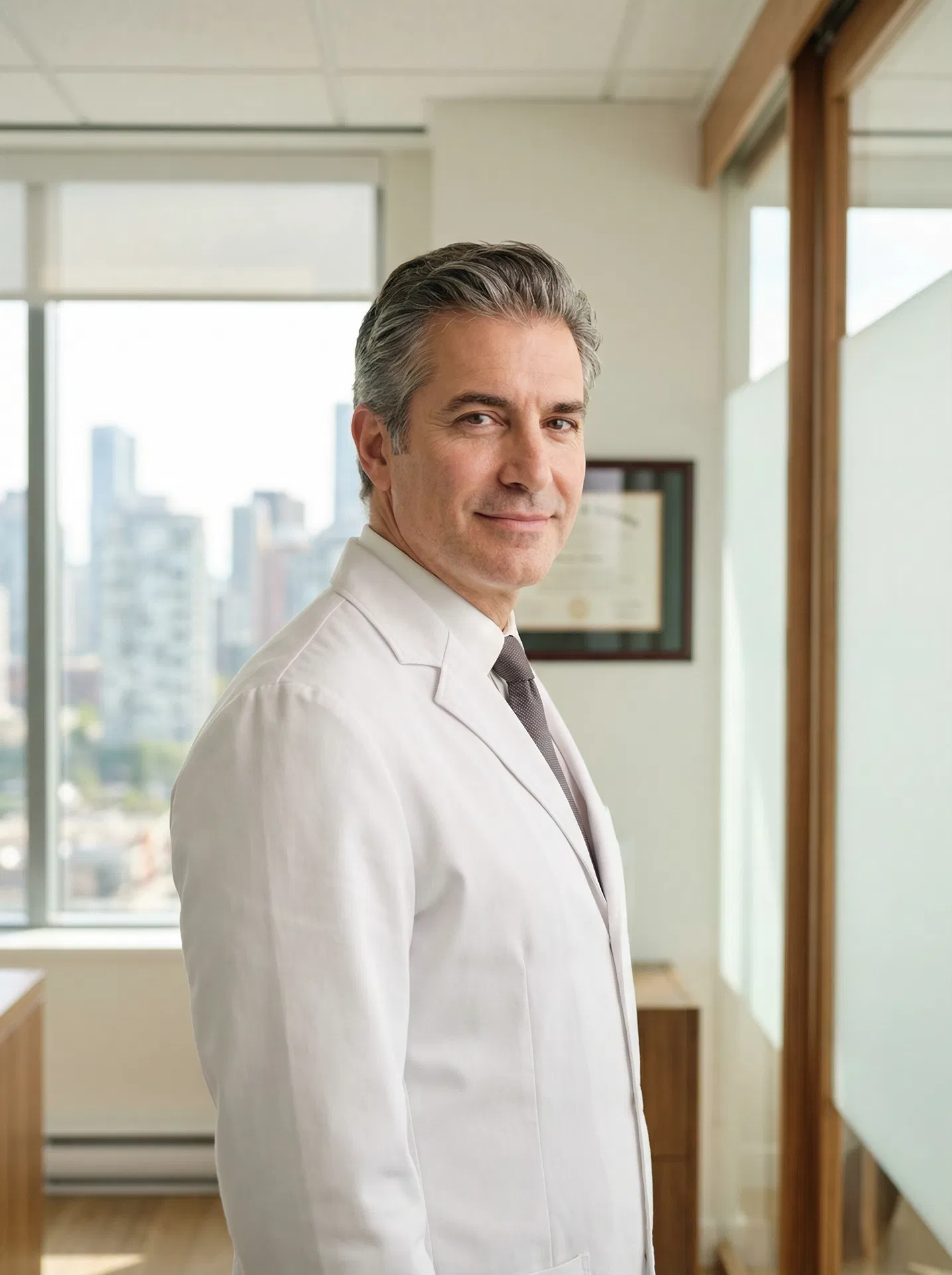
Dr. Thomas Buonassisi, FRCSC, ABFPRSAuthor · Reviewer
Facial Plastic Surgeon · Founder, 8 West Clinic · Vancouver, BC
Dr. Buonassisi is a dual board-certified facial plastic surgeon with over 25 years of experience in facial surgery exclusively. He has performed over 2,500 rhinoplasties and is the founder of 8 West Clinic in Vancouver. All content in the Knowledge Hub is written or reviewed directly by Dr. Buonassisi.
FRCSCABFPRSAAFPRSABOHNS
Free Resource
The Vancouver Rhinoplasty Guide
40+ pages written by Dr. Buonassisi. Candidacy, techniques, recovery, costs, and how to choose a surgeon. Free — no commitment required.
<h2>What should you expect during your one-week follow-up appointment?</h2> <p>At your one-week follow-up appointment after rhinoplasty, the most significant event is the removal of your cast. This moment can be both exciting and nerve-wracking for patients, as it marks the first time you will see your new nose without the cast. Dr. Buonassisi emphasizes that while the process is painless, it can still be a tense moment filled with anticipation. The removal of the cast allows for a clearer view of the results and is an essential step in your recovery journey.</p> <p>During this appointment, Dr. Buonassisi will also assess your healing progress. He may gently squeeze any swollen tissue to give you a better initial view of your new nose. It's important to remember that some swelling and minor bruising may still be present, which is completely normal at this stage. The doctor will provide you with mirrors to view your new profile from different angles, helping you to appreciate the changes made during surgery.</p> <h2>How will you feel after your rhinoplasty surgery?</h2> <p>Post-surgery experiences can vary widely among patients. Many, like Ashley, report feeling surprisingly well immediately after the procedure. However, it’s common to experience discomfort in the days following surgery, such as swelling and difficulty breathing through the nose. Ashley described feeling great initially but then experiencing discomfort due to the need to sleep upright and breathe through her mouth. This is a typical part of the recovery process, and most patients adapt over time.</p> <p>As the days progress, many patients begin to feel more like themselves, gradually returning to their daily routines. Ashley noted that she was able to work from home and felt a steady improvement in her comfort level throughout the week. It’s essential to listen to your body and take the time you need to rest and heal, as recovery can be a gradual process.</p> <h2>What are some common post-operative challenges?</h2> <p>After rhinoplasty, patients may encounter a few common challenges during their recovery. One of the most frequently mentioned issues is the need to sleep in an upright position, which can be uncomfortable for those who are used to sleeping on their sides. Ashley shared her experience of adjusting to back-sleeping, noting that while it wasn’t ideal, it was necessary for optimal healing.</p> <p>Additionally, breathing through the mouth can be uncomfortable and may feel awkward during social situations. Many patients express frustration with this aspect of recovery, as it can affect eating and talking. However, it’s crucial to remember that these challenges are temporary, and as healing progresses, normal breathing will return.</p> <h2>What should you know about swelling and bruising?</h2> <p>Swelling and bruising are natural parts of the healing process after rhinoplasty. Dr. Buonassisi explained that patients may still have some swelling around the nose and eyes even after the cast is removed. For Ashley, she noticed a bit of swelling and a small black eye, which is not uncommon. Understanding that these symptoms are part of the healing journey can help set realistic expectations for patients.</p> <p>Most swelling will gradually subside over the weeks following surgery, but it can take time for the final results to become fully apparent. Dr. Buonassisi will monitor your progress and provide guidance on what to expect as you continue to heal. Patience is key, as the final outcome of your rhinoplasty will reveal itself in the months following your procedure.</p> <h2>How can you support your recovery at home?</h2> <p>Supporting your recovery at home is crucial for achieving the best results after rhinoplasty. Following Dr. Buonassisi's post-operative care instructions is essential, including maintaining an upright position while sleeping and avoiding strenuous activities. Staying hydrated and eating a balanced diet can also aid in the healing process.</p> <p>Additionally, managing discomfort with prescribed medications and following any specific recommendations for nasal care will help ensure a smoother recovery. Ashley mentioned that despite some discomfort, she remained positive about her experience, which can significantly impact your overall recovery. Engaging in light activities, as tolerated, can help you feel more like yourself as you heal.</p>
Full Transcript
My name is Doctor. Buonassisi and I'm a board certified facial plastic surgeon with a practice in Vancouver, Canada. I've been specializing in cosmetic rhinoplasty for almost twenty years and I'm here to answer your questions about this very interesting procedure. Happy patients are educated patients, and that's why every question is a good one. Alright. So it's been a week since your surgery. We're taking the cast off today. This doesn't hurt. Okay. But it's always kind of a, you know, tense moment because I'm wondering if it looks good, and you're gonna wonder if it looks good. So this will this will be pretty easy. We'll just slip it off. The first few days well, right after the surgery, I was, like, feeling so great, and I was so surprised. Like, I went back, and I was watering all the plants in my apartment and my mouth came over and I was just feeling so great. Then the next morning I woke up and I felt like I had been hit by like a bus. And it was kind of rough. Think mostly because I had to sleep upright and then I couldn't breathe at all through my nose. So I just kept waking up every hour, and my mouth was, like, so dry, and I just felt so uncomfortable. So I'm just gonna you've got a little bit of sort of swollen tissue. I'm just gonna squeeze some of that out a little bit so that on your first view, you don't see this big swollen nose. And you're gonna have a little bit of, some little, you know, blood clots and stuff underneath there. And those will all go away on your first shower. And I'll give you a mirror. Actually, I'll give you two mirrors. One of them looks straightforward. Oh my gosh. Why is this? And then the other one, if you look straightforward, just keep it forward like that, and then I'll bounce your profile at you. Oh my gosh. Oh my gosh. I love it. Yeah. It looks good. So much. I think it's pretty close to the images that we did. Wow. But then as the days kinda went by, like, slowly started to kinda get a little bit more used to, like, my routine and just kind of, like, easing into having a week of being lazy and enjoying it. And then the last two days, I actually went back to work, and I work from home, that was, really easy to do. Yeah. And I was really happy that I got to sort of get back on track as the week went by. And then today, right before my cast went off, like went out, I went out in public. I'm feeling pretty good today. So, I feel like it was like a pretty steady, like up curve all week. I can't believe that's my face. It's funny, Why? It'll a little time to get used to. You can hold those too if you want. Thank you. I was sitting there at this all day. And I think, you know, not much you really Oh my gosh. You're you're gonna be a little swollen up here still, so you'll look like Oh, okay. Was it Avatar? Is that the movie? I felt like sleeping was really uncomfortable at first, and I think I think even now I I still have to sleep upright, so it's not really ideal. I'm usually like a side sleeper, but I think I'm gonna try and stick with sleeping on my back for now because I've heard it, like, much better just wear your face and your back in general, so maybe it's a good thing. And then breathing through my mouth is, like, not that comfortable. I feel like a gross like, I don't know. I feel a bit gross breathing through my mouth all the time or if I'm eating with friends or my boyfriend, I feel gross having to breathe through my mouth and eat through my mouth. So I'd say it was uncomfortable, but at the same time, whenever anyone would ask me if it hurt or if I wasn't having a good time, I would just say, I'm really, really happy it happens. I'm not really gonna complain too much. So a bit uncomfy, but not that bad. There's a tiny little nick that I make in the skin on the two sides Oh. And that's where the little chisel goes in, and that'll be a little swollen for, I don't know, a week or two, and then that goes away. I have a little bit of a black eye, so maybe my boyfriend will be feeling uncomfortable walking with me. But, no, I feel fine. It took me a couple days to feel comfortable walking around with the nose cast on, and felt really shy about it. But after a few days, I just I just kinda had to get over it. So we've just removed Ashley's cast. Her surgery was a week ago, and I'm just gonna talk through with you what you can and can't do. Okay. First thing I think best ideally is just take a long shower, let water run over your nose. Okay. Don't scrub it. Just let the water kinda dissolve the little blood clots so you can start splashing water into your nose. And then we asked you to get a a a spray bottle with some salt water, and you can start spraying that in your nose as well. I guess if someone else is thinking about having a rhinoplasty, I think it's really important to do a lot of research on who's doing it. I think if you're trusting someone with your face, you should make sure you're trusting that person a lot, and make sure you're working with, like, a reputable clinic. Otherwise, you can put a little makeup on the nose if you want, but don't use anything that's difficult to remove because I just don't want you scrubbing and all that kind thing. If you have to sneeze, let it out your mouth. Okay. No sunglasses, so don't put anything on the bridge of your nose for six to eight weeks. Okay. And, you know, get a get a hat. You know, be careful about activities that are are risky. You know, obviously, you're not gonna kickbox or something like that. But, you know, even just, you know, casual game of basketball or something like that's a little risky. So I wouldn't really I would avoid that kind of stuff for about six to eight weeks. Okay. So there's some little stitches. You can barely see them, but there's some little stitches here that are gonna dissolve on their own. Okay. And I would just let them let let those just wash off when you take the shower. Even though there's, like, a little bit. I guess when I have the shower, it'll probably come off. Okay. Yeah. You can you can take a little cloth and very, very gently wipe the area, and little bits will come out each day. And I would guess in a day or two, those those will be gone. Okay. There are some stitches on the inside, though, and they're a little stiffer than these. And they're gonna last for several months, and they're the ones that are kinda holding your tip together Oh, okay. Tilted position and and securing your your, the two cartilages together, which we did to make them a little narrower. Okay. And those are gonna last for about four months. Don't pull on those. And but also don't be alarmed if you feel them if you poke around up there. Okay. I think I might have accidentally disturbed one yesterday. I'm sure it's fine. Okay. What you may notice is that when you exercise, your nose may become a little swollen, and that's very common. I would avoid really hot places like hot yoga. Okay. If you're gonna do cardiovascular exercise, I would do it outdoors so you stay you stay cool. The one thing that you could do is there's one area right about here Yeah. That seems a little squishy to me. Oh, yeah. And it's where you have most of your hump. Okay. So your your hump was sort of projecting forward and projecting your skin forward. Okay. Now that we've taken that hump back, you still have that skin. And that skin is gonna have a tendency to be a little swollen or fill up fill up with fluid. So if you can sort of squish that down onto the bridge of your nose, and you can do a where it is? Yeah. So not everybody needs to tape, but I think there's one area here that I kinda get the impression that maybe it's a little bit puffy. Can you take a look at that? Yeah. It's right about there. Oh, okay. And so what I would suggest is that you put a little bit of compression on that. You don't really see it on your profile, but I'm it's just very subtle. But rather than pushing down on it with your finger all day Right. You could just use a tape to do that. And Okay. And often what I suggest is if people see an area that maybe has got a bit of a curve to it, that they put a tape on it at night. Oh, okay. So all you're doing is basically just squishing that skin down with a little tape. You can use any tape, but we use something called Steri Strips. Okay. That just squishes that area down. You could put one above and below if you wanted, but that's kind of the main part that I would think, you know, know, you might benefit from. Okay. The idea is that you wanna wear that, you know, maybe at night when when you don't care what it looks like, for a few weeks. When you when you're not wearing it, if you're not getting swollen and it looks just fine, then you're done. You don't need to wear it anymore. And not everybody needs it. I think maybe for a couple of days is all you'll need it for. Okay. Just to kinda compress that tissue so it doesn't stay swollen. Okay. I don't think I told you guys this, but even before I had started working with you I looked up Doctor. Bune Assisi because he's rated number one in Canada. I had spent so long going through all the articles and the before and afters and just seeing I think seeing the before and afters and reading articles from the clinic you're thinking about going to tells you so much about what you need to know about the surgeon that you're about to see. Another thing that I tried to do a lot is kind of temper my expectations. Think at first I was looking at pictures of like celebrities who have had nose jobs and just like or I don't know models with really really tiny noses and I kind of had this thought of thinking that if you're gonna get a nose, I'm gonna look like them but then I had to sort of recalibrate my thinking and realize that I'm just gonna look like myself with a different nose and I think that helped me a lot too. Thanks for listening and check back regularly for new questions and my honest answers about rhinoplasty.
[{"href":"/rhinoplasty-knowledge-hub/dr-buonassisi-cast-removal-and-nasal-taping-with-ashley-at-1-week-post-rhinoplasty","title":"Dr. Buonassisi: Cast Removal and Nasal Taping with Ashley at 1 Week Post Rhinoplasty"},{"href":"/rhinoplasty-knowledge-hub/dr-buonassisi-explains-body-dysmorphic-disorder-and-rhinoplasty","title":"Dr. Buonassisi Explains Body Dysmorphic Disorder and Rhinoplasty"},{"href":"/rhinoplasty-knowledge-hub/dr-buonassisi-answers-how-is-rhinoplasty-computer-imaging-different-to-self-photoshopping","title":"Dr. Buonassisi Answers: How is Rhinoplasty Computer Imaging Different to Self Photoshopping"},{"href":"/rhinoplasty-knowledge-hub/dr-buonassisi-talks-about-4-iffy-rhinoplasty-requests","title":"Dr. Buonassisi Talks About 4 Iffy Rhinoplasty Requests"},{"href":"/rhinoplasty-knowledge-hub/drbuonassisiexplainhealthconcernsforrhinoplastyv1-1080p","title":"dr._buonassisi_explains_health_concerns_for_rhinoplasty_v1 (1080p)"},{"href":"/rhinoplasty-knowledge-hub/sample-title-3-x-explained","title":"Sample Title 3: X Explained"}]