Candidacy & Consultation
Rhinoplasty in Canada: What to Consider Before You Choose a Surgeon

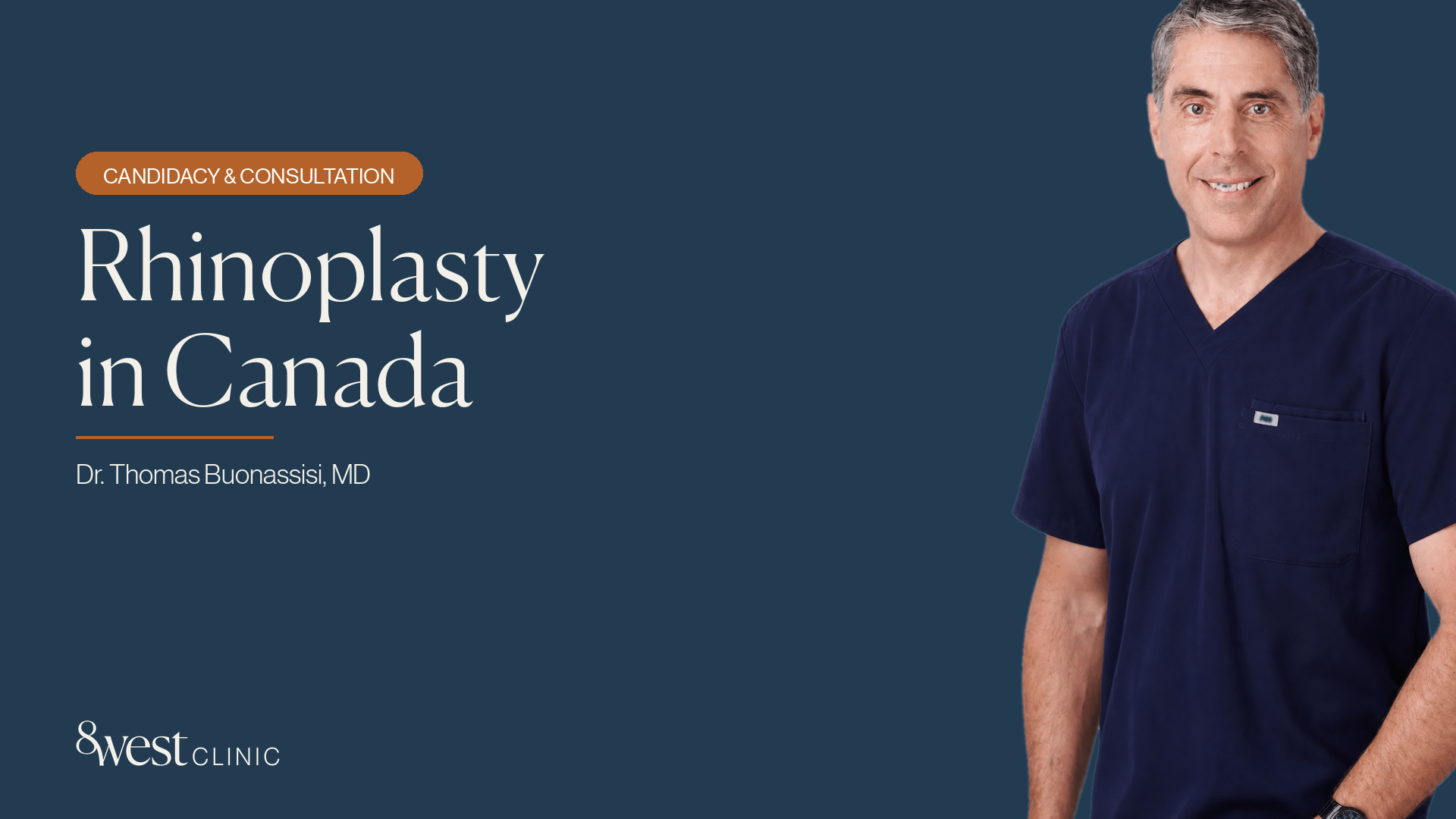
Dr. Buonassisi · Rhinoplasty in Canada: What to Consider Before You Choose a Surgeon
Dr. Thomas Buonassisi, MD, FRCSC — Otolaryngology – Head & Neck Surgeon with a practice limited to facial plastic surgery, 8 West Clinic, Vancouver, BC.
Dr. Buonassisi is certified by the American Board of Facial Plastic and Reconstructive Surgery (ABFPRS) and the American Board of Otolaryngology – Head and Neck Surgery (ABOHNS), and is a Fellow of the Royal College of Physicians and Surgeons of Canada (FRCSC) and the American Academy of Facial Plastic and Reconstructive Surgery (AAFPRS). He co-founded 8 West Clinic — a rhinoplasty-focused practice in Vancouver, BC — with his wife Angie Buonassisi, with two locations in Vancouver and North Vancouver, with patient education as a founding principle of the practice.
Dr. Buonassisi has been educating patients on rhinoplasty for over 15 years and has published hundreds of educational videos across YouTube and Instagram — with content going back over a decade. Every article and video in the Knowledge Hub is written or reviewed directly by Dr. Buonassisi.
We've selected the most relevant and helpful for you here in our Rhinoplasty Knowledge Hub. For patients researching rhinoplasty, the following resources may be helpful: All about rhinoplasty, rhinoplasty before and after photo gallery, and learn more about 8 West Clinic and our rhinoplasty consultation.
Researching Rhinoplasty
Every week I speak with patients who have spent months — sometimes years — researching rhinoplasty before they ever book a consultation. Some have compiled spreadsheets of surgeons. Others have watched dozens of videos and read every forum thread they could find. A few have already had one rhinoplasty somewhere else and are coming to me to correct it. What I notice in almost every one of these conversations is the same thing: people are asking the right questions, but they are not always sure how to evaluate the answers. This article is my attempt to give you a framework for thinking through rhinoplasty in Canada — from the initial decision to the moment you choose a surgeon and commit to a date. I am writing this from the perspective of someone who has performed over 2,500 rhinoplasty procedures over a 25-year career dedicated exclusively to facial plastic surgery. I am not writing it to sell you on coming to see me. I am writing it because I believe that a well-informed patient makes better decisions, has more realistic expectations, and ultimately has a better experience — regardless of where they have their surgery.
If you have had a prior procedure, I make a point of discussing the unique challenges of revision rhinoplasty. These cases often require careful analysis of scar tissue, the amount and quality of remaining cartilage, and a different surgical plan than a primary rhinoplasty to achieve a durable, natural result.
Is Rhinoplasty the Right Decision for You?
Before you think about surgeons, techniques, or geography, the most important question is whether rhinoplasty is the right choice for you at this point in your life. Rhinoplasty is a significant surgical procedure. The results are permanent. The recovery is real — most patients are presentable within two to three weeks, but the final result takes a full year to settle as residual swelling resolves.
The nose you see at six weeks is not the nose you will have at twelve months. I ask every patient two questions early in our consultation. The first is: what specifically bothers you about your nose? Not "I just want it to look better" — I want to understand the precise concern. Is it the bridge? The tip? The width at the base? The profile versus the front view? The more specific you can be, the more useful the conversation becomes.
Vague dissatisfaction is harder to address surgically than a clear, anatomically specific concern. The second question is: how long have you felt this way? Rhinoplasty is not a decision to make in response to a recent breakup, a difficult period at work, or a comment someone made. The patients who do best are those who have carried a consistent, considered concern about a specific aspect of their nose for a long time — not those who are reacting to a moment.
If you are under eighteen, I would encourage patience. The nose continues to develop through the mid-teens, and operating before growth is complete can compromise the result. If you are a younger adult, there is no rush. If you are an older adult considering rhinoplasty alongside other facial procedures, that is a conversation worth having — the relationship between the nose and the aging face is something I think about carefully in those cases.
Understanding What Rhinoplasty Can and Cannot Do
One of the most important things I try to establish in a consultation is a clear picture of what is achievable for your specific anatomy. Rhinoplasty is not a procedure where a surgeon simply executes a design you bring in from Instagram. The result is a negotiation between your goals and your anatomy.
Your skin thickness matters enormously. Patients with thick skin have more soft tissue overlying the cartilage framework, which means that even precise structural changes may not be visible at the surface. Patients with thin skin show every detail — which means both the improvements and any irregularities are visible. Neither is better or worse; they simply require different approaches and different expectations.
Your existing cartilage structure matters. The strength, shape, and position of your lower lateral cartilages, your upper lateral cartilages, and your septum all determine what is possible. A surgeon who has not examined your anatomy carefully — ideally with photographs and computer imaging — cannot give you a meaningful sense of what your result will look like.
Your ethnic background matters. Not in a way that should limit what you can achieve, but in the sense that a good rhinoplasty should harmonize with your face, not impose a single aesthetic ideal onto it. I perform rhinoplasty for patients from many different ethnic backgrounds, and the goal is always a nose that looks natural and balanced for that person's face — not a nose that looks like it belongs to someone else.
How to Evaluate Surgeons in Canada
Canada has a number of skilled rhinoplasty surgeons, and the process of choosing one deserves more care than most people give it. Here is how I would approach it if I were a patient. Start with credentials, but do not stop there. In Canada, the relevant credential for a surgeon performing rhinoplasty is a Fellowship of the Royal College of Physicians and Surgeons of Canada (FRCSC) in a surgical specialty.
Surgeons performing rhinoplasty come from different training backgrounds — otolaryngology – head and neck surgery, plastic surgery, and oral and maxillofacial surgery are the most common. What matters more than the specific specialty is whether the surgeon has dedicated their practice to the face, and specifically to rhinoplasty.
I am a specialist in Otolaryngology – Head and Neck Surgery, with a practice limited exclusively to facial plastic surgeries. I hold my FRCSC in that specialty, and I am also Board Certified by the American Board of Facial Plastic and Reconstructive Surgery (ABFPRS) and a Fellow of the American Academy of Facial Plastic and Reconstructive Surgery (AAFPRS).
I completed a fellowship in Facial Plastic and Reconstructive Surgery through the Australasian Academy of Facial Plastic Surgery. I mention these not to impress you, but to illustrate what a focused, verifiable credential picture looks like. When you are evaluating any surgeon, ask specifically what their training pathway was and what proportion of their practice is rhinoplasty.
Looking at Results
A surgeon's before and after gallery is one of the most important things you can review. Look for patients who have a similar starting point to yours — similar skin type, similar concern. A gallery that shows only the most dramatic transformations is less useful than one that shows a range of realistic outcomes. Look for naturalness. The best rhinoplasty results are the ones where you cannot tell a rhinoplasty was done — where the nose simply looks right for the face.
Be cautious of computer imaging that shows dramatic changes. It is a useful communication tool, but it is not a promise. The imaging should help you and your surgeon get on the same page about direction — not serve as a guarantee of outcome.
Understanding Techniques
You will encounter a great deal of terminology when researching rhinoplasty. Open versus closed rhinoplasty. Structural versus preservation rhinoplasty. Cartilage grafting. Osteotomies. You do not need to become an expert in surgical technique to make a good decision, but a basic understanding helps.
The most important thing to understand is that technique should follow anatomy and goals — not the other way around. A surgeon who performs only one technique regardless of the patient's anatomy is not the right surgeon for every patient. Ask your surgeon which approach they are recommending for you and why.
I also counsel patients about newer technologies, including ultrasonic rhinoplasty, which uses piezoelectric instruments to shape bone with precision while minimizing soft-tissue trauma. In selected cases this can translate into reduced bruising and a more predictable osteotomy, but it is not appropriate for every patient.
The Consultation
The consultation is where you gather the information you need to make a decision. Come prepared. Bring photographs of your nose from multiple angles. Bring a written list of your specific concerns. Be honest about your medical history, your medications, and your expectations.
Pay attention to how the surgeon listens. Do they ask questions? Do they examine your nose carefully? Do they explain their thinking? A surgeon who rushes through the consultation, who agrees with everything you say, or who makes promises that sound too good to be true is a surgeon to be cautious about.
Ask about the surgeon's complication rate and revision rate. Ask what happens if you are not happy with the result. Ask about the recovery process in detail. These are not rude questions — they are the questions a well-informed patient asks.
A Final Note
Rhinoplasty is one of the most technically demanding procedures in all of surgery. The nose is small, the changes are subtle, and the margin for error is narrow. The surgeons who do it well have typically spent years developing their skills and continue to refine their approach with every case.
Take your time. Do your research. Choose a surgeon whose results you respect, whose credentials are verifiable, and with whom you feel genuinely heard. The decision you make about your surgeon is the most important decision in this entire process.
Free Resource
The Vancouver Rhinoplasty Guide
40+ pages written by Dr. Buonassisi. Candidacy, techniques, recovery, costs, and how to choose a surgeon. Free — no commitment required.
Download Free →8 West Clinic
The Vancouver Rhinoplasty Guide
40+ Pages
Continue Reading